



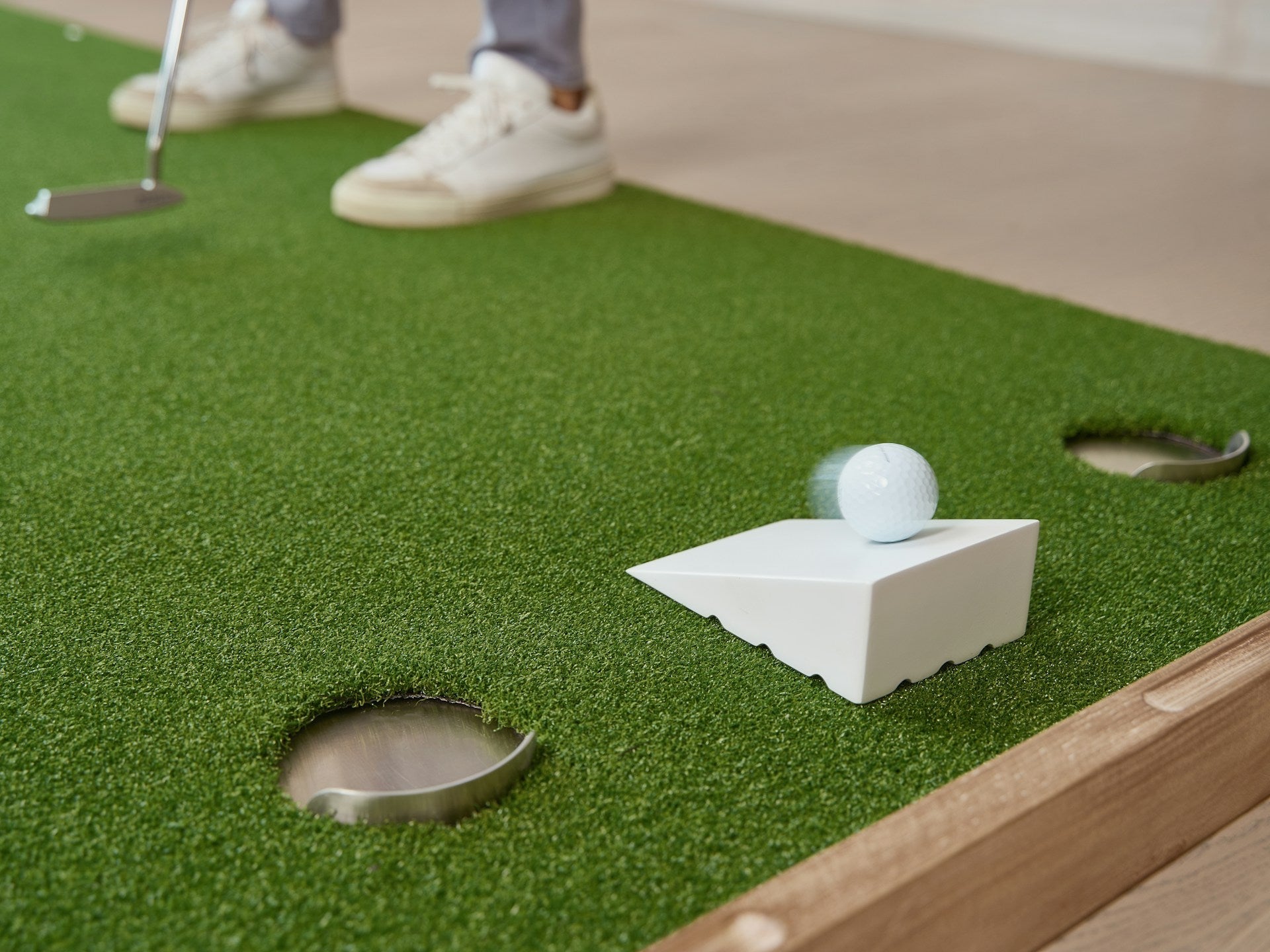
Golf putting decides scorecards. On a typical round, roughly 40% of strokes happen on the green, and most missed “good rounds” come down to three-putts.
Learning how to make a putting stroke that starts the ball on line with reliable pace turns bogeys into pars and pars into birdie looks.
This guide breaks down golf putting into setup, technique, green reading, and practice. Use these putting tips to build a repeatable putting stroke under pressure.
The Perfect Putting Setup
First and foremost, let's see how a perfect putting stroke setup looks like.
Stance, posture, and alignment
A dependable putting stance starts with feet about hip-width apart, weight balanced, and toes roughly parallel to the target line.
Add a soft knee flex and tilt from the hips, not the waist. The back stays long, and the arms hang naturally under the shoulders. “Skeletal alignment” matters. When bones stack efficiently, the body sways less, making the putter stroke easier to repeat.
Aim shoulders, hips, and feet slightly left or square, but keep the putter face aimed at the start line. The head position should feel quiet. Eyes over the ball or just inside it helps many golfers see the line and control the putter path.
Practice is easier when gear is organised. A comfortable carry or cart option like staff favourite golf bags keeps training simple and consistent.
Read also: How to stop topping the golf ball
Grip styles for better control
Grip pressure should feel light-to-moderate, with stable wrist angles. The goal is control without tension. The standard grip works for many players, especially when the palms face each other and the thumbs sit on top.
Reverse overlap can calm the hands by locking the index finger over the lead hand. Left-hand low often helps with face control and steady wrist angles, especially on short putts where the putter face can flip.
No grip is “best” for everyone. Testing grip styles builds comfort, which builds confidence, which improves golf putting tips under pressure.
You may also like to read: Strong vs Weak Grip in Golf
Ball position and eye line
For many golfers, ball position slightly forward of centre promotes a gentle upward strike and cleaner roll. Too far back can add skid and reduce speed control. Too far forward can encourage a push if alignment breaks down.
Eye line influences aim. Eyes directly over the ball often improves the start line, while “just inside” can suit a natural putting arc. Use a simple check: drop a ball from the bridge of the nose. If it lands on or near the ball, the setup is close.
Repeatable setup is a major part of how to putt well, even before the stroke begins.
Building a Consistent Putting Stroke
Below, you'll find a very detailed breakdown of how to build a consistent stroke for your putting shots.
1. The shoulder-powered pendulum motion
A reliable putting stroke is driven by the shoulders, not the hands. Think of the arms and shoulders moving together as one unit. Picture the “triangle” formed by shoulders and arms. Keep that triangle intact to protect tempo and reduce face twisting.
This is the classic pendulum motion: back and through with steady rhythm, minimal wrist breakdown, and a stable head. Some players feel a straight-back-straight-through motion. Many naturally swing on a slight putting arc based on posture and putter design.
Either can work if the putter face returns square and the low point stays consistent. The priority is a repeatable putter stroke.
Keep checking our blog for more golf guides: How to swing a golf clubs for beginners
2. Controlling speed and distance
Speed control is the fastest way to cut three-putts. Great golf putting is often better pace, not perfect line. Match backswing and follow-through length. For most putts, the follow-through should be as long as, or slightly longer than, the backswing.
Let gravity and rhythm power the stroke. A simple “one-and-two” cadence supports smooth acceleration and consistent strike. On long putts, widen the arc and keep tempo steady rather than “hitting.” That preserves face control and improves distance control.
Equipment feels matters. Testing head shapes and inserts from best golf putters can help dial in pace and consistency. Re-check these putting tips when distance control slips: ball position, tempo, and stable wrists.
3. Face angle and consistent centeredness
The face angle is huge. A tiny change in the putter face at impact can miss the hole from short range. Prioritise returning the clubface square at impact while striking the center of putter face.
Quick test: mark the ball, hit five putts, and check the mark transfer on the face. Off-centre strikes reduce roll and alter the start line.
Another test: place two tees as a “gate” just wider than the putter head. If the face twists, the putter clips a tee.
Feedback tools help. Explore practice putting drills using mirrors, gates, and face-angle trainers. Centred contact is a skill. Practice until the center of the putter face feels automatic, even when the read is tricky.
Mastering Green Reading & Pre-Shot Routine
Start by reading the green from afar. Look for overall slope, drainage directions, and visible tiers. Next, walk to the ball and read from behind it. Then read from behind the hole to see the opposite perspective. Pick a start line and choose a close target spot on that line, such as a discoloured blade or edge of a patch.
This “spot putting” approach sharpens aim and simplifies the task of starting the ball where it needs to begin. Commit to the picture. Use visualization to “see” the ball rolling on the chosen line and falling in. Strong green reading supports how to make a putting stroke with confidence, because the mind stops second-guessing mid-stroke.
Developing a repeatable pre-shot routine
A consistent pre-shot routine turns practice skill into on-course performance. It also stabilises nerves on must-make putts. Use a simple sequence: read, choose start spot, rehearsal strokes for pace, set the face, set the feet, final look, then roll it. Practice strokes should match intent. Feel the length for distance control and confirm the face returns square.
Limit extra thoughts. One line cue and one pace cue is enough for most golfers learning how to putt reliably. Technology can support consistency. Consider green-reading gadgets for golf like alignment tools or digital levels. Keep the pre-shot routine identical on short putts and long putts. Same process, different stroke length.
Drills & Practice Tips for a Better Putting Stroke
Check out these effective drills to try on the green:
-
Gate drill: place two tees just outside the putter head and two more tees 12–18 inches ahead for the start line. Roll putts through both gates.
-
Chalk-line drill: snap a straight line or use a string. Set the face square and roll balls along the line to train face control.
-
Ladder drill: putt to tees at 10, 20, 30, and 40 feet. The goal is finishing within a putter-head length past each tee for pace.
-
Coin or marker drill: place a coin 12 inches ahead on the target line. Start the ball over it to groove the start line.
These putting drills build start line, pace, and impact control. Repeat them with the same tempo and pendulum motion. For more structure and instant feedback, browse practice putting drills designed for face angle and strike.
Make sure to also check some effective putting practices in our blog.
How to build confidence and consistency for putting
Short, focused sessions win. Ten minutes of intentional golf putting beats an hour of mindless rolling. Build a routine: 10 straight putts from three feet, 10 from six feet, then a ladder for distance control.
At home, use a mat and a gate drill to rehearse a quiet head and stable triangle. Outdoors, rehearse reads and real slopes. Use consistent equipment in practice. Training with quality golf balls for practice improves feedback on roll and speed.
Small tools help too. Items like ball markers, alignment sticks, and towels from must-have golf accessories keep sessions organised. Confidence grows when practice has standards. Track makes, track misses, and keeps targets realistic. These putting drills should feel challenging but achievable, reinforcing a repeatable putter stroke.
Mental Approach – Visualization, Confidence, and Adaptability
Putting exposes doubt. The mind wants to steer the putter, which changes tempo and face angle. Use visualization as a bridge between read and execution. See the start line, see the pace, then trust the body to deliver. Commitment matters more than perfection. A confident stroke on a slightly wrong read often beats a shaky stroke on the perfect line.
A useful mindset is “act committed until it becomes real.” Confidence is built through decisive routines and small wins. Adaptability is part of elite golf putting tips. Grain, moisture, wind, and spike marks change roll, so stay flexible on pace. When nerves rise, return to basics: stable setup, simple cue, steady pendulum motion, and a clear target spot.
Final Thoughts: Keep Improving Your Putting Stroke
Lower scores come from fundamentals repeated under pressure: a stable putting stance, a square face, centred contact, and reliable pace. Use a clear pre-shot routine and commit to the start line. Then train with structured putting drills that sharpen strike and distance control.
The best path is steady improvement. Small upgrades in setup, green reading, and confidence transform every golf putt opportunity.
For players refining equipment feel, explore current deals on best golf putters and quality golf balls for practice. Round out practice with practice putting drills, must-have golf accessories, and green-reading gadgets for golf.
Keep practising, keep the motion simple, and keep chasing better rolls. That’s how to make a putting stroke that holds up all season.